Christ is Omniscient. So, Why Doesn't He Know The Timing Of His Return?

Pastor Hammond

Recently, I was asked to explain my understanding of Jesus' statement in which he indicated that only the Father knows when Christ will return:

Mt 24:36 But of that day and hour knoweth no man, no, not the angels of heaven, but my Father only. 37 But as the days of Noe were, so shall also the coming of the Son of man be.

This is difficult because we understand that Christ is God the son and that he therefore has perfect knowledge (omniscience).  How may we reconcile his omniscience with his claim that he doesn't know when he will return?

Here's a short answer:  Christ has always possessed his divine nature.  He did not become less divine when he took on a human nature at his incarnation.  However, when he came, he chose not to fully exercise all of his divine attributes. This would include his omniscience – in terms of his knowledge of when he would return.

This answer is consistent with the idea is expressed in Philippians 2:6-8:

Php 2:6 Who, being in the form of God, thought it not robbery to be equal with God: 7 But made himself of no reputation, and took upon him the form of a servant, and was made in the likeness of men: 8 And being found in fashion as a man, he humbled himself, and became obedient unto death, even the death of the cross.  

You may be wondering why Christ evidently chose to not possess knowledge of the timing of his return. 

First, note that the verses that follow Mat 24:36-37 appear to address the need for people in the Tribulation to maintain a state of readiness for the return of Christ -- not knowing exactly when he will return. No one in the Tribulation will know exactly when he is coming (Not even Christ!) -- and so all should take great care to get ready and maintain a state of readiness.

Secondly, Christ's choice to not know the time of his return may be intended to communicate his submission to the plan of the Father and his reliance upon the Spirit of God.  If correct, this is a wonderful example for us!    

We Care About People Who Identify as LGBTQ+

Pastor Robert Hammond

Long Hill Baptist Church cares about people who identify as members of the LGBTQ community.  There’s several important things that we want you to know:

  1. We love you.  And God loves you, too. If fact, Jesus proclaimed, “For God so loved the world, that he gave his only begotten Son, that whosoever believeth in him should not perish, but have everlasting life” (John 3:16).

  2. In love, we share that, according to the Bible, a person doesn’t belong in the LGBTQ+ community simply because they lack a natural attraction to people of the opposite biological gender. In fact, the Bible makes it clear that some people are born without a natural attraction to people of the opposite biological gender.

    See for yourself: Matthew 19:12 says,
    “For there are some eunuchs, which were so born from their mother's womb…”

    What does that mean? Historically, a eunuch was typically a man who was castrated so that he would not be distracted by physical attraction to women. We understand that, in Matthew 19:12, the Bible uses this fact to illustrate the truth that some people are born without a natural attraction to opposite biological gender (some are born so “from their mother’s womb”). Importantly , however, that doesn’t mean that God intends for those people to identity with the LGBTQ+ community.

    Why would we say that? In the Bible, God specifically prohibits homosexual behavior. For example, in Leviticus 18:22, God commands, “Thou shalt not lie with mankind, as with womankind: it is abomination.” And so the Bible makes it very clear that God views practicing homosexuality as a sin. This matters because, according to the Bible, any sin will condemn us to punishment in a very real and eternal hell (Romans 6:23) — unless we find God’s forgiveness.

3. The good news is that Jesus Christ offers forgiveness of sin when turn to to him in faith.

In Romans 3:23, the Bible says that "all have sinned, and come short of the glory of God."  God's perfect holiness and justice requires that a penalty be paid for sin.  In fact, in Romans 6:23, the Bibles teaches that "the wages of sin is death."  The good news is that the son of God -- the Lord Jesus Christ -- paid that penalty for us by shedding His blood and dying upon the cross in our place.  It is only through repentance (turning to Christ from sin) and placing one's faith in Christ that our sins are forgiven.  Romans 6:23 says, "the gift of God is eternal life through Jesus Christ our Lord."  If you will repent and receive Christ as your savior, you can know for certain that you have been forgiven and that you have eternal life.

Thankfully, when we come to Christ with a humble, repentant faith, we find both forgiveness of all sin and strength to put off old sinful habits.

Related Articles:


What's in a Name?

sermon-whats-in-name.jpg

Whereas the gospels of Matthew and Mark portray Christ as King and Servant, respectively, Luke and John emphasize the humanity and deity of Christ, respectively.

Chapter one of John’s gospel contains a wonderful catalog of fourteen names and titles for our Savior. Ten times, Christ is called by his personal name, Jesus, which means savior (Matthew 1:21). Throughout this single chapter our Savior is also called “the Word” (1:1-4), “God” (1:1), “the true light” (1:7-9), “Jesus Christ” (1:17), “the only begotten Son” (1:18), “the Lord” (1:23), “the Lamb of God, which taketh away the sin of the world” (1:28, 36), “Rabbi” (or Master) (1:38, 49), “the Son of God” (1:34, 49), “Messias” (meaning the Christ) (1:41), “Jesus of Nazareth” (1:45), “the king of Israel” (1:49), and “the Son of Man” (1:51).

These names are worthy of much personal study. They help us to better understand the nature of our Savior. For example, his title “Lord” refers to his supreme authority.  Because of his unique authority, Jesus alone is to be called “Rabbi” or “Master” (Matthew 23:7-8). Our Lord’s authority stems from the fact that he is “the Word.” John associates this title with Christ’s divinity and his role as creator of all things (1:1-3). Jesus was not created. Rather, he created all things (Ephesians 3:9; Colossians 1:16), working together with Father and the Holy Spirit (Genesis 1:2). Mormons falsely teach that Christ is a created being who became a god. Similarly, the Jehovah’s Witnesses falsely teach that God the Father created the Son.

Please join me in praying for the LORD to help us to understand the meaning and significance of the names and titles of our Savior. Pray for the LORD to give us boldness to defend the truth that Christ created all things. And pray for the LORD to help us to submit to Christ as both our Lord and Savior!  

Copyright (c) 2020. Robert W. Hammond

How Should Christians Respond to COVID?

Pastor Robert Hammond, Long Hill Baptist Church, Trumbull, CT (Updated January 9, 2025)

People around the world are understandably concerned about the ongoing risk of contracting COVID.  This article provides information about avoiding infection, together with information about how we can be physically and spiritually prepared for COVID-19.  

Being Physically Prepared

Avoiding infection.  See details about current recommendations at https://www.cdc.gov/covid/index.html

Being Prepared Spiritually

Be reminded that God has an answer for our anxiety.  In Philippians 4:6, the Lord commands us to not be filled with worry about anything. “Be careful for nothing,” writes Paul. “But in every thing by prayer and supplication with thanksgiving let your requests be made known unto God.”  

Instead of worrying, we are to pray about our worries. And we are called to do so with thankfulness. Be thankful that God desires to hear our worries.  And be thankful that he desires to answer our prayers. Believers who obey these commands are promised a blessing:  “The peace of God, which passeth all understanding, shall keep your hearts and minds through Christ Jesus” (Philippians 4:8). Note also that the Lord commands us to focus our minds on godly things rather than fearful things (Philippians 4:8).

Remember that God sometimes uses illness to bring people to Christ.  The blind man who received sight in John 9 came to faith in Christ as a result of his trial!  Pray that many people will come to Christ as a result of COVID-19. No doubt, this disease is causing many lost people to be more willing to hear your testimony of salvation and eternal life in Christ.  Be prepared to share the truth that the the gospel of Jesus Christ is the only true way to be prepared for the possibility of death.

Be reminded that God sometimes uses our physical illnesses to grow us. In James 1:2, we are commanded to “count it all joy when ye fall into divers temptations; Knowing this, that the trying of your faith worketh patience.” The word “temptations” has the idea of trials. The Lord desires that we be grateful for trials because he uses them to grow us spiritually. 

Understand that God sometimes uses illnesses in order to demonstrate his power. In John 9, the disciples learned that a certain man had been born blind in order to create an opportunity for Jesus to demonstrate his power by giving the man sight (9:3). When Christ chooses to heal, he has power to heal.

But also understand that the Lord sometimes allows illnesses to continue so that he may continue demonstrating his power! That was the case with Paul's “thorn in the flesh” (2 Corinthians 12:6-7). Paul prayed for healing. But instead of healing Paul, Christ answered Paul’s prayer by promising grace (power) to endure the trial. And so Paul did not despair. Instead, he proclaimed, “Most gladly therefore will I rather glory in my infirmities, that the power of Christ may rest upon me”  (2 Corinthians 12:9). Paul continued, “Therefore I take pleasure in infirmities... for when I am weak, then am I strong” (2 Corinthians 12:10).

When the Lord chooses to allow an affliction to continue, rely upon his grace to continue -- knowing that he has good purposes for the trials (Romans 8:28). 

Understand that God sometimes uses physical illness to protect us from spiritual danger. In 2 Corinthians 12, Paul revealed that he was tempted to be prideful about his ministry. He understood that the Lord used a “thorn in the flesh” to protect him from that spiritually-dangerous pride.  Ask God to help you accept that, in his wisdom, he sometimes uses illness to humble us. 

Understand that God sometimes uses illness to encourage us to testify of him. Sometimes, the Lord uses physical trials to encourage his people to testify to others about his power in our lives. After the man in John 9 received sight, he testified to others about the power of Christ. Paul also testified to the Corinthian church about the power he found in Christ to continue despite not being healed. Whether or not God chooses to heal us, we may testify about his power in our trials (2 Corinthians 12:9).

Be reminded that illness is not always the result of our own sin. According to the Bible, illness and death are a direct consequence of Adam’s sin in the garden (Genesis 3). Prior to Adam’s sin, there was no death (Romans 5:12). When Adam sinned, God placed a curse upon all of creation.  Illness and death are two of the results of that curse. Some of the illnesses that we experience simply reflect this truth.

Understand that some illnesses are the result of spiritual attack. Job is an example of a man who suffered illness that was not related to his own sin. His friends repeatedly insisted that he suffered because of his sin.  However, the Bible records that Job was “perfect and upright, and one that feared God, and eschewed evil” (Job 1:1). Job’s illness was the result of spiritual battle rather than his own sin.  

Remember that God sometimes uses illness to correct us. While not all illnesses are the result of our own sin, our personal sin can indeed result in God correcting us through illness. For example, Paul told the Corinthian church that some of their members were weak or sick because they had sinned by participating in the Lord’s Supper unworthily (1 Corinthians 11:30). He also told them that some had died because of that sin!

What’s the biblical answer for illness that results from our personal sin? In James 5:13-15, we are instructed to pray and to confess our sin. The afflicted are instructed to “call for the elders (pastors) of the church; and let them pray over him, anointing him with oil in the name of the Lord.” Throughout the Bible, oil pictures the Holy Spirit. If the Holy Spirit is convicting you about some specific sin, take a moment to confess your guilt. Ask the Lord to give you grace to turn from sin to obedience.

Be reminded that Christians should be prepared to demonstrate love to others. Christ commands all believers to “love thy neighbour as thyself” (Matthew 22:39). He taught that people would be able to identify his disciples by love they exercised (John 13:34-25). In the event of a growing epidemic, God’s people will have many opportunities to demonstrate love to both to one another and to the lost. Bear in mind that the Lord himself makes this love possible as we yield to him (Galatians 5:22).

In conclusion, Christians would be wise to remain prepared both physically and spiritually. Bear in mind that “all things work together for good to them that love God” (Romans 8:28).  Lord, help us to be prepared to glorify our Savior, to reach others and to benefit spiritually from the trials that lay ahead. 

Further Reading:

Our Certain Hope for Heaven

When I share the gospel I often ask people if they are certain if they will go to heaven.  They typically answer, “I hope so.” They lack a certain hope. That’s because people who don’t know the biblical way of salvation are usually trusting in their good works to earn their way into heaven. They lack confidence about going to heaven because they lack confidence that their works will be good enough to earn entry into heaven.

Our job is to share the truth that our works can never be good enough for heaven (Ephesians 2:8-9). The only work that matters when it comes to heaven is the work that Christ completed on the cross. Only those who come to Christ in repentant faith may know a certain hope of heaven (John 14:6). 

In the opening verses of John 14, the Lord comforted believers with the certainty of heaven. “I go to prepare a place for you,” said Jesus. “I will come again, and receive you unto myself; that where I am, there ye may be also” (John 14:2-3).  

Are you looking forward to heaven? Heaven is a perfectly holy place (Psalm 20:6). It is a place without sin or sinners (Revelation 21:8). None of the evil of this world will be there. Heaven is a place of spectacular beauty (Revelation 4:2-3, 21:18-21). None of the ugliness of this world will be there. Heaven is a place of humble worship (Revelation 4:8). None of the pride of this world will be there. And Heaven is a place where God’s people will rest from our earthly labor (Revelation 14:13).  

Heaven is the place where God’s people “shall hunger no more, neither thirst any more” (Revelation 7:16). It is where “there shall be no more death, neither sorrow, nor crying, neither shall there be any more pain” (Revelation 21:4). 

Consider your response to the certainty of heaven. Believers are called to “rejoice, because your names are written in heaven" (Luke 10:20). Believers are called to “Set your affection on things above, not on things on the earth” (Colossians 3:2). And believers are called to “lay up for yourselves treasures in heaven” (Matthew 6:20). That involves faithfully serving our Lord on this side of heaven.  

Father, help us to find comfort in our certain hope of heaven (Romans 15:13). And help us to humbly tell others how they may also know our certain hope! 


Learn more about the certain hope that we find in Christ.  See bit.ly/CertainHope

Copyright © 2020 Robert W. Hammond.

Feasts that Encourage our Faith

feast-of-tabernacles-sukot.jpg

Although we no longer celebrate the Old Testament feasts (Galatians 4:9-10), we praise God for using them to both picture Christ and to encourage our faith.

In John chapter 7, Jesus traveled to Jerusalem for the feast of tabernacles (or ingathering) (John 7:2, 10). This was the last of seven annual feasts that the LORD directed his people to celebrate (Exodus 23:16; Leviticus 23:41). During this seven-day celebration, the people lived in tents (or tabernacles) as a reminder that God rescued them from Egypt (Levitus 23:42-43). This feast occurred at the end of the autumn harvest season. That made it an ideal time to celebrate God’s bountiful blessings. It also pictures Christ and the blessings that he will pour-out upon his people during his future thousand-year Millennial reign on earth (Revelation 20:4; Isaiah 11:6-10; Zephaniah. 3:15, 17).

Take a moment to consider how the other Old Testament feasts picture Christ. First, see how the four springtime feasts picture the first coming of Christ.

Passover is the first spring feast (Exodus 12:7-14; Leviticus 23:4-8; Numbers 28). It pictures Christ’s death upon the cross. Passover celebrates the night in Egypt when the Lord “passed over” his people as he smote the first-born of the Egyptians. The Lord spared his people when they obeyed his command to take the blood of a sacrifice “and strike it on the two side posts and on the upper door post” of their houses” (Exodus 12:7). What a clear picture of both the blood that Christ shed upon the cross and the safety of those who trust in him and his blood! Not surprisingly, Paul called Christ “our passover” (1 Corinthians 5:7).

The feast of unleavened bread is the second spring feast (Ex. 23:15; Lev. 23:6-8). It pictures Christ’s call for his people to live righteously. Paul commanded the Corinthian church members to “Purge out therefore the old leaven, that ye may be a new lump, as ye are unleavened…”(1 Corinthians 5:7).

The feast of firstfruits is the third spring feast (Ex. 23:16; Lev. 23:9-14). It pictures Christ’s resurrection. Paul taught the Corinthian church “now is Christ risen from the dead, and become the firstfruits of them that slept” (1 Corinthians 15:20). Just as the firstfruits of the spring harvest encouraged hope of a greater fall harvest, Christ’s resurrection encourages the certain hope that all believers will be resurrected (1 Corinthians 15:42-44).

The feast of weeks (or Pentecost) is the fourth spring feast. It pictures Christ sending the Holy Spirit from the Father to indwell, comfort, and teach believers, which prepares us to go into all the world to carry-out the Great Commission (Acts 1:8). This demonstrates the love and faithfulness of our Savior and his desire to equip us for his service.

The remaining three annual feasts are celebrated in autumn. They picture the second coming of Christ. The feast of trumpets is the first autumn feast (Leviticus 23:23-25; Numbers. 29:1-6). It pictures Christ’s return at the Rapture. Paul taught the Thessalonian church that the Lord “shall descend …with the trump of God …” (1 Th. 14:6). On that great day, believers will receive a heavenly body that is eternal and incorruptible (1 Corinthians 15:50-58)!

The Day of Atonement (Yom Kippur) is the second autumn feast (Leviticus 23:26-32; Numbers 29:7-11). It pictures Christ as the way of salvation for Israel. Zechariah prophesied , “In that day there shall be a fountain opened to the house of David and to the inhabitants of Jerusalem for sin…” God is not finished with the Jewish people (Zechariah 13:1).

As we have seen, the feast of tabernacles (or ingathering) is the third autumn feast. It pictures Christ as the source of future Millennial blessings.

The prophecies pictured by the spring feasts have been fulfilled in Christ’s death, resurrection, and sending of the Holy Spirit. The fulfillment of those prophecies should encourage our faith that the future events depicted by the three autumn feasts will indeed be fulfilled. The trumpet will sound! Israel will find salvation in Christ! And Christ will bless his people in the Millenium!

Copyright © 2020 Robert W. Hammond.

Bible Listening Tips for People With Low Vision

bible-podast.jpg

People who are learning to live with low vision or blindness may encounter difficulty finding a good solution for listening to the Bible. While various apps and other solutions are available, many users have difficulty learning to navigate the content without the benefit of vision. Some potential solutions are discussed below.

  1. King James Bible Radio. iPhone users may use the Apple music app to listen to the “King James Bible Radio.” This online radio station provides a continous 24-hour-a-day reading of the King James Bible. iPhone uses who are comfortable using Siri may simply say, “Hey Siri, play King James Bible Radio.” The benefit of this solution is its simplicity. There’s virtually no set-up required. The main drawback is that you may only listen to the passage that’s being read at any given time, i.e. there’s no option to navigate to a specific passage.

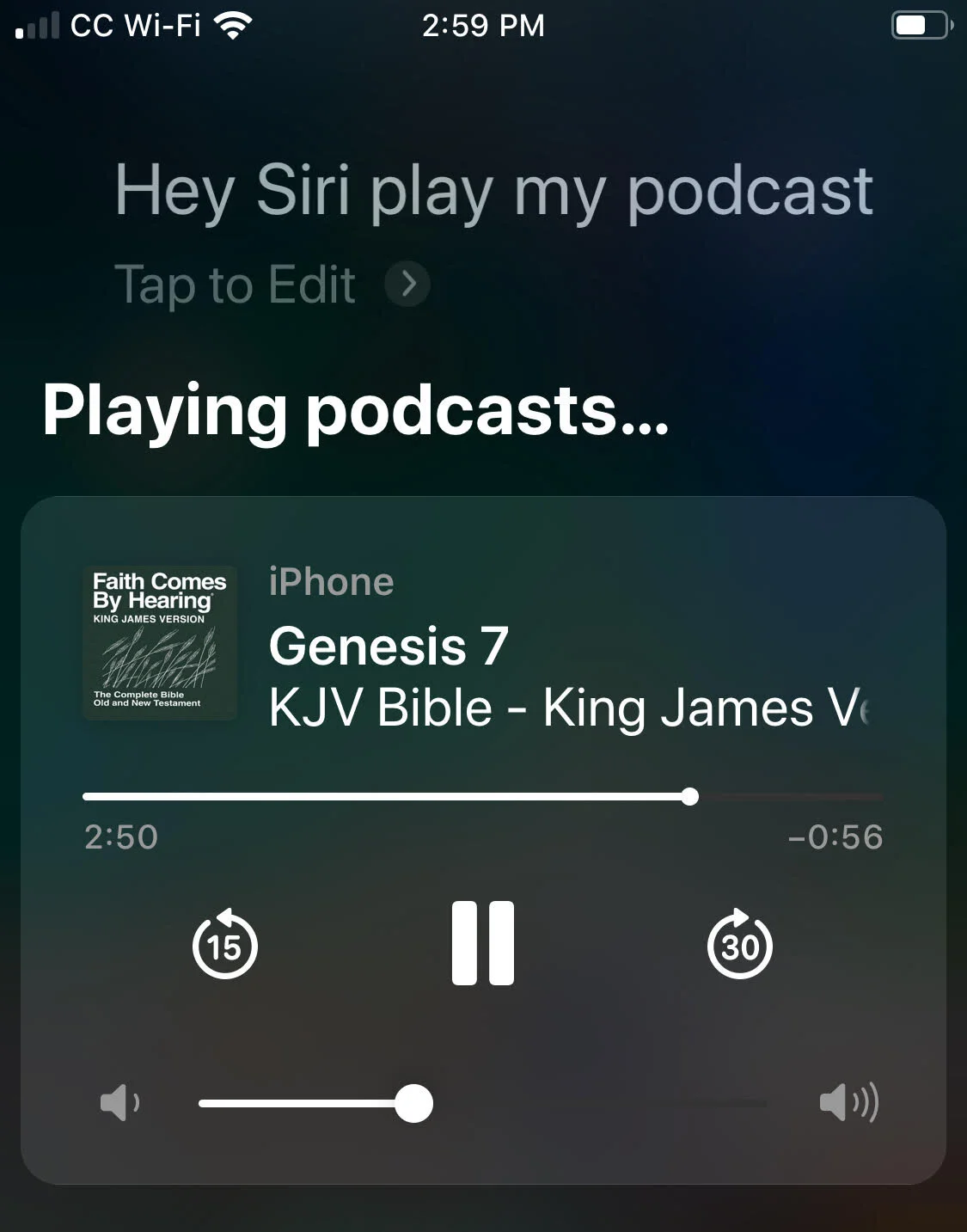
  2. Podcast Bible. iPhone users may utilize the Apple Podcast app to listen to the King James Bible. The “Faith Comes by Hearing - King James Bible” podcast is an excellent solution that treats each chapter of the Bible as a podcast episode. To begin listening, search for the title in the Apple Podcast app. Then tap on the desired podcast and tap “subscribe.” Chapters may then be downloaded in advance or streamed.

    Once the podcast is subscribed, iPhone users who are comfortable using Siri may simply say, “Hey Siri, play my podcasts.”

    The main benefit of this solution is that it enables users to select chapters to read. A care-provider may pre-select chapters to download. Alternatively, a user may simply begin playback at the first episode (Genesis 1) and automatically proceed through the Bible. Again, each episode is a chapter of Sctipture.

  3. iPhone Accessability Features. The iphone has a number of so-called accessability features that are designed to help those with low vision. These feature range from increasing the size of text to bolding text to a feature that reads that text on the screen. To explore these features, tap on the grey “settings” icon then tap on “Accessibility” in the Settings menu. Some of the features include:

    1. Magnifier - Turn on this feature to use the iPhone camera to magnify anything in your surroundings. Once enabled, just triple-click the Home button to start the magnifier. When using the magnifier, you may use two fingers to “pinch in” or pinch out” to adjust the magnification.

    2. Display & Text Size. Within this section, you may access features that bold text, increase the size of text and more.

    3. Spoken Content - Turn this iPhone feature on to enable the phone to read text appearing on most screens. Once enabled, just use two fingers to swipe down from the top of the screen that you want to hear. The phone will automatically begin reading the screen.

Related articles:

Readers are welcome to send feeback, together with other helpful suggstions.

Send Feedback

keywords: accessible Bible, blind, blindness, low vision, vision loss. temporary blindness

God's Great Purpose for Allowing Great Storms

storm-clouds.jpg

GOD HAS GREAT PURPOSES FOR ALLOWING GREAT STORMS. See Psalm 107:23-31: They that go down to the sea in ships, that do business in great waters; 24 These see the works of the LORD, and his wonders in the deep. 25 For he commandeth, and raiseth the stormy wind, which lifteth up the waves thereof. 26 They mount up to the heaven, they go down again to the depths: their soul is melted because of trouble. 27 They reel to and fro, and stagger like a drunken man, and are at their wits' end. 28 THEN THEY CRY UNTO THE LORD IN THEIR TROUBLE and he bringeth them out of their distresses. 29 He maketh the storm a calm, so that the waves thereof are still. 30 Then are they glad because they be quiet; so he bringeth them unto their desired haven. 31 OH THAT MEN WOULD PRAISE THE LORD FOR HIS GOODNESS, and for his wonderful works to the children of men!

Is it OK for Christians to Vape or Smoke?

Pastor Robert Hammond

vape.jpg

This short article discusses biblical principles that apply to the use of nicotine, together with practical help for people who desire to stop using nicotine.

Many have concluded that it’s ok for Christians to smoke or vape because the Bible doesn’t directly address this topic. However, the Bible does teach a variety of principles that should inform our decision.

First, we are called to yield control to the Holy Spirit rather than to allow ourselves to be controlled by a chemical substance. This is precisely the point of Ephesisan 5:18, where the Lord commands, “be not drunk with wine, wherein is excess; but be filled with the Spirit.” The point of that verse is that God desires us to yield control of our lives to him alone. When we yield control to alcohol or nicotine, we necessarily cease yielding ourselves to God — especially in the case of addiction to alcohol or nicotine (or any other substance).

Second, we are called to demonstrate love to other Christians. In 1 John 4:7, the Lord commands us to “…love one another: for love is of God…” Smoking or vaping around others is unloving for several reasons: (1) It may be an annoyance to others; (2) it may encourage others to smoke or vape and (3) exposure to second-hand smoke has been shown to be dangerous to others.

Third, Christians do well to consider that the Lord has provided our bodies for his purposes. (Revelation 4:11). We should work to remain healthy so that we may continue to serve God. Further, Christians should consider that our bodies our indwelt by the Holy Spirit. in 1 Corinthians 6:19, the Lord asks, “What? know ye not that your body is the temple of the Holy Ghost which is in you, which ye have of God, and ye are not your own?”

Last, it is also worth noting that the cost of vaping or smoking can impede our desire to be good stewards of our finances.

In conclusion, Christians should refrain from smoking or vaping in order to (1) demonstrate love to others, (2) to avoid addiction — which necessarily involves yielding control to something other than God and (3) to be good stewards of our finances and our physical bodies so that we may serve God as long as he desires.

If you are already addicted to nicotine or any other substance, consider these suggestions:

  1. Pray and confess the sin;

  2. Ask God for grace to stop using the substance. And ask him to help you seek comfort from him;

  3. Get support from your pastor or someone else in your church. In addition, ask your doctor about programs to help manage the physical aspect of the addiction. In the case of smoking or vaping, this may include using a nicotine patch for a short time to help wean your body off nicotine.

Praise God for his grace and comfort!

If your’re not certain that you know Christ as your Savior, please learn more here.

Copyright © 2020 Robert W. Hammond.

Dealing with Bitterness Biblically

Pastor Robert Hammond, Long Hill Baptist Church, Trumbull, CT

Nick Vujicic is a Christian evangelist who was born without arms and legs.

Nick Vujicic is a Christian evangelist who was born without arms and legs.

See these resources for overcoming bitterness:

Related Bible Verses:

Free articles: (click titles to read)

  • Dealing With Bitterness Biblically by Pastor Robert Hammond of Long Hill Baptist Church. This outline addresses topics including:

    • The definition and sinful nature of bitterness;

    • The causes and consequences of bitterness;

    • The Biblical way to overcome bitterness;

  • How to Deal with Bitterness by Dr. Terry Coomer of Hope Biblical Counseling and Training Center, a ministry of Hope Baptist Church, North Little Rock-Sherwood, Arkansas.      

 Related Books:

What Can I Do When I'm Feeling Hurt?

Pastor Robert Hammond, Long Hill Baptist Church, Trumbull, CT

We’ve all dealt with situations that caused us to feel hurt. Thankfully, the Bible prescribes a way to overcome our hurt feelings. Download this Bible study to learn how to implement biblical answer to feeling emotionally hurt.

Download

Source:   This study is adapted from How to Deal with Hurt by Dr. Terry Coomer (with permission of the author).  For more information, please visit Dr. Coomer’s website at HopeBiblicalCounselingCenter.com

keywords: I feel hurt, I’m hurting, my feelings are hurt

What is biblical fellowship?   

(It’s more than enjoying a meal together!)    
 
Pastor Robert Hammond | Long Hill Baptist Church, Trumbull, CT

In Acts 2:42, the Jerusalem church is described as having “…continued stedfastly in the apostles' doctrine and fellowship, and in breaking of bread, and in prayers. To say that they “continued stedfastly” means that they pursued those things with earnest. They persevered. They were constantly diligent in things including “fellowship.”

What exactly is fellowship?  The word underlying “fellowship” literally refers to joining together or partnering with others -- especially for a beneficial purpose.  It implies serving one another (e.g. Ec. 4:9-10), and/or serving others (e.g. 2 Cor. 8:1-4) and/or partnering to reach others with the gospel (e.g. Phil 1:3-5).

The biblical definition of fellowship appears to be closely related to the literal definition of “church.”   Recall that “church” literally refers to an assembly of people who are called out - typically for a specific purpose.  Church members (those who are called out from the world) are called to assemble together in order to partner in fulfilling God’s purposes, i.e. to fellowship! In short, we are both called-out from the world and called together to partner in fulfilling specific biblical purposes.   

Consider the following related observations from Scripture

  1. We are called to fellowship both with the Lord and with other believers -- and we are called to refrain from attempting to fellowship with unbelievers:

    A. (1 John 1:3) “That which we have seen and heard declare we unto you, that ye also may have fellowship with us: and truly our fellowship is with the Father, and with his Son Jesus Christ.”

    B. (Ephesians 5:11) “And have no fellowship with the unfruitful works of darkness, but rather reprove them.”

    C. (2 Corinthians 6:14) “Be ye not unequally yoked together with unbelievers: for what fellowship hath righteousness with unrighteousness? and what communion hath light with darkness?”

    Biblical fellowship occurs among believers (1) within a church assembly or (2) between like-minded churches.  It specifically cannot exist between believers and unbelievers.  

Three biblical purposes of fellowship:

  1. Ecclesiastes 4:9 illustrates the principle of fellowship for the purpose of mutual benefit (serving one another):
    Ecclesiastes 4:9 “Two are better than one; because they have a good reward for their labour. 10 For if they fall, the one will lift up his fellow: but woe to him that is alone when he falleth; for he hath not another to help him up.” Here, we find a practical benefit of maintaining close daily fellowship with other believers, i.e. we can help each other “up” when we “fall.”

  2. In 2 Corinthians 8:1-4, Paul illustrates the principle of fellowship as joining together / partnering for the purpose of serving others.

    There,  Paul writes that the Macedonian churches asked him to take their financial gift to Jerusalem.  Paul referred to their desire to partner with him to deliver the gift as  “fellowship of the ministering to the saints.”

    (2 Corinthians 8:1) “Moreover, brethren, we do you to wit of the grace of God bestowed on the churches of Macedonia; 2 How that in a great trial of affliction the abundance of their joy and their deep poverty abounded unto the riches of their liberality. 3 For to their power, I bear record, yea, and beyond their power they were willing of themselves; 4 Praying us with much intreaty that we would receive the gift, and take upon us the fellowship of the ministering to the saints.”

    Romans 15:26 evidently refers to the same episode as 2 Cor 8.  There, the word that is sometimes translated “fellowship” is translated “contribution” -- underscoring the idea that fellowship involves partnership for a beneficial purpose:   “For it hath pleased them of Macedonia and Achaia to make a certain contribution for the poor saints which are at Jerusalem.”

  3. Other passages  illustrate the idea of fellowship as joining together / partnering for the purpose of reaching others (sharing the gospel)

    In Galatians 2:9, Paul explains that came into a partnership with James, Cephas (Peter) and John to share the gospel:   (Gal 2:9)  “And when James, Cephas, and John, who seemed to be pillars, perceived the grace that was given unto me, they gave to me and Barnabas the right hands of fellowship; that we should go unto the heathen, and they unto the circumcision.”

    In Philippains 1:3-5, Paul testified that he prayed for the church there, thanking God for their “fellowship in the gospel,” i.e. their supportive partnership with Paul in his evangelist effort:

    (Phil 1:3-5)  “3 I thank my God upon every remembrance of you, 4 Always in every prayer of mine for you all making request with joy 5 For your fellowship in the gospel from the first day until now;”   (They had evidently supported him financially).

Where Did the Bible Come From?

Bible-KJV.jpg

Eight Reasons to Believe that the Bible Came From God.

1.     The Bible writers Professed that their words came from God.

The Old Testament prophet Jeremiah testified that he wrote words given to him by God:  “Then the LORD put forth his hand, and touched my mouth. And the LORD said unto me, Behold, I have put my words in thy mouth.” (Jeremiah 1:9)

In Mark 12:36, Mark records Jesus’s assertion that Psalm 110 was inspired by God:  “For David himself said by the Holy Ghost, The LORD said to my Lord, Sit thou on my right hand, till I make thine enemies thy footstool.”

In the New Testament, Paul writes, “ All scripture is given by inspiration of God …” (2 Timothy 3:16). And Peter writes, “For the prophecy came not in old time (the Old Testament period) by the will of man: but holy men of God spake as they were moved by the Holy Ghost. (2 Peter 1:21).

2.     The Personal experience of Christians testifies that the Bible is supernatural;

The experience of converts in the New Testament.  For example, the apostle Paul was converted to biblical Christianity while traveling for the purpose of persecuting Christians.  Having been converted to Christianity, he became perhaps the most fervent preacher of the Bible recorded in the New Testament – despite the severe persecution that he suffered throughout his evangelistic efforts.  

The personal experience of Christians today.  Countless individuals around the world today report that their lives have been transformed by the Bible. This is consistent with the biblical claim that “All scripture is given by inspiration of God, and is profitable for doctrine, for reproof, for correction, for instruction in righteousness: That the man of God may be perfect, throughly furnished unto all good works.” (2 Timothy 3:16-17).

The experience of Christians is also consistent with the biblical assertion that “…the word of God is quick (alive), and powerful, and sharper than any twoedged sword, piercing even to the dividing asunder of soul and spirit, and of the joints and marrow, and is a discerner of the thoughts and intents of the heart.” (Hebrews 4:12)

3. The Preservation of the Bible despite concerted attempts to eliminate it throughout history.  The preservation of God’s word is consistent with the biblical promise that God would preserve his words.

In Psalm 12:6-7, we read, “The words of the LORD are pure words: as silver tried in a furnace of earth, purified seven times. 7 Thou shalt keep them, O LORD, thou shalt preserve them from this generation for ever.”

In Matthew 5:18, Jesus states, “For verily I say unto you, Till heaven and earth pass, one jot or one tittle shall in no wise pass from the law, till all be fulfilled.” And in Matthew 24:35, Jesus adds, “Heaven and earth shall pass away, but my words shall not pass away.” 

4.     The Perfect internal consistency of the Bible testifies to its supernatural origin. 

Despite the fact that 40 different men wrote over 1,600 years – some of whom had no access to each other’s writing – the Bible is perfectly consistent with regard to doctrine, themes, places and dates.

5. The fulfillment of Bible Prophesy testifies to the supernatural original of the Bible. The Bible contain more than 1,800 detailed prophesies.  All of those prophesies have either already been fulfilled or relate to future events.

For example, the Old Testament prophet Daniel prophesied the major world powers, including the Medo-Persian Empire (539-331 BC), the Greek empire (331-146 BC) and the Roman empire (146 BC – AD 410).  Daniel wrote during the Babylonian Empire (605-539 BC), i.e. roughly 200 years prior to the Greek Empire and 400 years before the Roman Empire.

Also note that the Bible accurately predicted both the parentage of Christ (Gen. 3:15; Isa 7:14; Isa 11:1) and his place of his birth (Micah 5:2 vs. Matt 2:1).  And Daniel predicted the timing of the crucifixion of Christ.

Further, in Luke 9:22, Jesus prophesied both his death and resurrection: “…The Son of man must suffer many things, and be rejected of the elders and chief priests and scribes, and be slain, and be raised the third day.”

6.     The archeological evidence for Bible People testifies to the truth of the Bible.

At least 53 people who are named in the Old Testament have been found referenced in archeological discoveries – including kings of Israel & Judah, Moab, Assyria, Babylonia and Persia.

The Hittites. At one time, skeptics used the Bible’s 25 references to an unknown Hittite people as proof that the Bible was a myth. However, beginning in the late 19th century, archeologists began uncovering evidence of a Hittite people. 

7.     The archeological evidence for Bible Places testifies to the truth of the Bible.

In addition to Jericho, biblical places such as Haran, Hazor, Dan, Megiddo, Shechem, Samaria, Shiloh, Gezer, Gibeah, Beth Shemesh, Beth Shean, Beersheba, Lachish, and many other urban sites have been discovered and excavated.

In 2015, archeologists discovered ruins of a place in modern Jordan that fits the description of the city of Sodom.  They found ruins a city that was known for its acceptance of homosexuality. They found evidence of a prosperous city that grew large and then suddenly ceased to be inhabited (for more than 700 years).  They discovered a layer of ash together with markings that are consistent with burning. In addition, pottery shards display signs of exposure to extremely high temperatures.  (Source: Archaeologist Believes to Have Discovered Location of Biblical Sodom, But One Thing Remains a Mystery (2015), https://www.breakingisraelnews.com/51870/sodom-found-archaeological-evidence-proof-biblical-account-health-and-science/, accessed October 7, 2018)

8.     The universal tradition of Bible Passages testifies to the supernatural original of the Bible.

For example, many cultures around the world have a tradition of a global flood that appears to reflect the Genesis flood account. Archeologists have discovered evidence that the Mesopotamians, Egyptians, and Greeks all had a tradition of a catastrophic flood. Further, there is evidence that early Chinese people also had knowledge of specific details of the biblical flood account. The evidence includes the fact that the traditional Chinese symbol for boat consists of three elements: (1) the symbol for a vessel, (2) the symbol for the number eight and (3) the symbol for people. This is consistent with the Genesis account of eight people being saved from a flood in an ark — a vessel with eight people!


Mind Your T’s & Y’s: Understanding King James Pronouns

ye-shall-know-the-truth.jpg

Pastor Hammond

Living according to “every word that proceedeth out of the mouth of God” (Matt. 4:4) requires that we make an effort to learn to understand every word of scripture.  Yet, any honest pastor will admit that the Elizabethan-era English of our King James Bible can be challenging. One of the first challenges that we face is the so-called Elizabethan pronouns, i.e. thou, thee, thy, thine, ye, and you.

It is fair to ask if these “old fashioned” pronouns really matter – especially given that most modern Bible versions have replaced them with simpler, more familiar words.  For example, modern translations typically replace “ye” with “you.”  While that change may seem reasonable, readers must understand that dropping the use of the Elizabethan pronouns necessarily obscures the meaning of the Greek and Hebrew words that underlie our English translation.  In fact, when translators change “ye” to “you,” they are necessarily changing God’s words!

Let’s take a closer look at the issue.   Recall that the New Testament is translated from Greek.  Biblical Greek differentiates between singular pronouns that refer to one person (thou, thee, thine) and plural pronouns that refer to multiple people (you, ye). Biblical Greek also differentiates between pronouns that serve as subjects and objects in a sentence.  Unfortunately, modern English no longer maintains a system of pronouns that bear the same level of precision.  Fortunately, however, the Elizabethan English of our King James Bible utilizes a system of pronouns that perfectly reflects the precision of the original Greek. 

You may be wondering if this level of grammatical precision is actually important.  Consider the King James translation of John 3:7.  There, Jesus said, "Marvel not that I said unto thee (singular, object form), ye (plural, subject form) must be born again."  The use of these precise pronouns in our  King James translation makes it clear that, while Jesus was speaking to one man (Nicodemus), his message was that all people must be born again.  However, the New International Version (NIV) obscures the fact that all must be born again; It translates  John 3:7 as “You should not be surprised at my saying, You must be born again.”  Because the NIV says "You must be born again," a modern reader would not likely understand that Jesus was actually telling Nicodemus that all people must be born again. 

Similar distinctions are made in the Biblical Hebrew underlying our King James Old Testament. Consider Exodus 4:15:  "And thou (2nd person singular, subject form) shalt speak unto him, and put words in his mouth: and I will be with thy (2nd-person singular,  possessive form) mouth, and with his mouth, and will teach you (plural, object form) what ye (plural, subject form) shall do" (KJV).

One commentator notes that, in the above verse, we see the pronouns "thou," "thy," "you," and "ye," all fulfilling a specific grammatical function.  Modern translations are more likely to read:  "You shall speak to him ...and I will be with your mouth,... and will teach you what you shall do."  In choosing to simplify the translation, they obscure the precision and clarity of the underlying Hebrew words.  However, our King James Bible makes it clear that the LORD told Moses that he (Moses) was to speak to Aaron, and that He (the LORD) would then teach both of them (not just Moses) what they were to do.

Ok, so how can I remember the meaning of each pronoun?

Here’s a simple rule:  In our King James bible, pronouns that begin with “T” are always singular (i.e. they refer to one person); Pronouns that begin with “Y” are always plural (i.e. they refer to multiple people).   Someone observed that a helpful way to remember this rule is that “t” resembles one "stick" whereas “y” pictures two (or more) sticks stacked together.  

Going a step further:  Biblical Greek also uses different forms of pronouns to identify subjects and objects in a sentence.  Recall that, in a sentence, a subject is the person who is performing an action.  The object is a person or thing that is receiving action.  Consider this sentence:   “Mary is feeding the baby.”   “Mary” is the subject, i.e. the one performing the action.   “Baby” is the object, i.e. the one upon whom the action is being performed.  

Praise God for our Authorized King James Bible – an accurate translation of God’s preserved words.

A Helpful Chart of King James Bible Pronouns: 

  1. “T” pronouns are singular (and always 2nd person)

    1. Thou = subject form

    2. Thee = object form

    3. “Thy” & “Thine” show possession

  2. Y” pronouns are plural (and always 2nd-person)

    1. Ye = Subject form (performs action)

    2. You = object form (received action) Remember: If someone offers you an I-O-U, you expect to receive something. (IOU ~ YOU)

    3. Your(s)” shows possession

Remember:  "T" pronouns are always singular. "Y" pronouns are always plural.

Want to learn more?  


Should Christians Practice Taekwondo?

Pastor Robert Hammond

In this brief article, I address a question that was posed to me regarding the religious aspects of Taekwondo and the suitability of Taekwondo for Christians. 

Taekwondo_girl.jpg

In a 2012 article, Taekwondo teacher Ørjan Nilsen argued that practicing Taekwondo should not be viewed as a problem for Christians[1].  Essentially, he claimed that Taekwondo has no religious origin. 

However, in the same article, Nilsen acknowledged that Taekwondo has been “influenced” and “shaped” by both Buddhism and Taoism.  And he admitted that practicing Taekwondo requires knowledge of certain aspects of both Buddhism and Taoism.  Some quotes from his article include:

  •  “... The founders and early pioneers said Taekwondo did not contain any religious foundation, but that it was influenced by ...Buddhism. Taoism also played a part in shaping the culture of the founders of Taekwondo ... it too has influenced the way we practise Taekwondo…”

  • “…Besides the students oath we do have one "big" remnant from Taoism included in our studies through our practise of the Taegeuk pattern set. These patterns are in theory based on the philosophical foundation of Taoism ….”

  •  “…  Taekwondo does have influences ... that might stem from religion, and (requires) a very basic knowledge of Taoism and on a higher lever a very basic knowledge of Budhism …”

Similarly, a May 2013 article in Blackbelt magazine argues that practicing Taekwondo isn't necessarily inconsistent with Christianity.  However, the same article states, "In the martial arts, religion has an ... important role. It was crucial in the historical development of many arts, and it continues to dictate the ways in which many students think and act during practice sessions."

The above quotes document that experts in the martial arts admit: (1) Taekwondo has been influenced by both Buddhism and Taoism; (2) Practicing Taekwondo requires basic knowledge of certain aspects of both Buddhism and Taoism; (3) Students are typically influenced by the religious aspects of Taekwondo; and (4) Certain religious aspects of Taekwondo may be incompatible with Christianity.   

Why is the religious aspect of Taekwondo a problem for Christians? Buddhism is a false religion that teaches people to take refuge in Buddha, a man who is wrongly revered as a God-like being.  Similarly, Taoism is a false religion that teaches people to worship false Gods.  Taoism teaches the false doctrine of pantheism -- the idea that the universe is God.  As such, both Buddhism and Taoism are entirely incompatible with Christianity – which teaches that (1) the LORD is the one true God (1 Corinthians 8:6) and (2) faith in Jesus Christ alone is the only true way of salvation (John 14:6).  

What about those who would argue, "my class is safe because religion is never discussed?"  Consider this response from GotQuestions.org:   "the false religious overtones of Buddhism are there whether they are expressed verbally or not."  And consider this statement from the Blackbelt magazine article referenced above:  "More than a few Western students have converted to an Eastern religion simply because their martial art grew from that spiritual tradition."

Importantly, the Bible commands that we separate ourselves from false religious practices and from people who engage in those practices:

  • In the Old Testament, the Lord commanded his people to nether worship false gods nor "do after their works." (Ex. 23:24);
     
  • In the New Testament, the Lord requires church-age believers to separate from false religious practices.  In 2 Corinthians 6:17-18, God commands, “… come out from among them, and be ye separate, saith the Lord, and touch not the unclean thing; and I will receive you, 18 And will be a Father unto you, and ye shall be my sons and daughters, saith the Lord Almighty.”

Conclusion:  Christians should refrain from participating in Taekwondo as well as all of the various other forms of the martial arts.   

1] Source:  http://jungdokwan-taekwondo.blogspot.com/2012/01/religion-and-taekwondo.html


The Greatest Gift of All

Pastor Robert Hammond

Over the years, I have read innumerable Christmastime articles that reflect on the true meaning of Christmas.  Predictably,  they contend that Christmas is less about receiving gifts and more about time for family, reflection, and, of course, for giving gifts. 

That all sounds good.  But, I really like to receive gifts.  

One Christmas season, I was invited to share the story of the best gift that I ever received.  A friend invited me to share my story with a woman in his family who has been fighting a terminal illness.   I quickly accepted the invitation to visit her at a local nursing home.

When I entered her room, I introduced myself and prayed with her. Then, I began telling her the story of the most wonderful gift that I had ever received.

I told her how, when I was a boy, a man took a book and told me the story of a Father who understood the importance of giving like no one else.  The man described a Father who was so concerned for others that he was willing to send his only son to die for them. 

I told her how that Father’s gift was motivated by unfathomable love.  And I told her that his son shared that love so perfectly that he was willing to shed his blood and to die for me. 

Puzzled, the women in the hospital bed turned away.  And then she turned back toward me. 

I explained that the book that was read to me was the Bible. And I explained that Father who was described to me is God the Father.   I continued that the son who was offered by his own Father is the long-prophesied Messiah, the Lord Jesus Christ. 

I explained that God the Father sent his son both to be born of a virgin in Bethlehem and to die on the cross at Calvary – exactly as had been prophesied in the Scriptures.  And I told her why he did that:  According the Bible, I am a sinner.  Because of that, I deserve death – eternal separation from God.  But, according to the Bible, “the gift of God is eternal life through Jesus Christ our Lord.”

I told her that I had received that gift and I explained how she might receive it, too.  I explained that the Bible teaches that our good works aren’t good enough to earn forgiveness.

I told her how Jesus said, “ye must be born again.”   And I told her that Peter, the Apostle, said, “Repent (turn away from sin) … and be converted, that your sins may be blotted out.” I explained that Salvation is a free gift that must simply be received by turning away from sin and by placing one’s faith in Christ. 

That night, she too decided to receive the greatest gift that I have ever received – the gift of eternal salvation.  She prayed and received Christ as her Savior. Because of her decision to receive Christ, she may know with certainty that, whenever her battle with illness ends, she will be in Heaven with her Savior.  That’s a great Christmas gift indeed.

Have you received the greatest gift of all – the Lord Jesus Christ?    

For the wages of sin is death; but the gift of God is eternal life through Jesus Christ our Lord. (Romans 6:23